Saturday, December 12, 2009

Additional Maryland Minerals at the Harvard Mineralogical Museum

This week's post follows through on the August 14 and October 2 posts about minerals collected in Maryland on display in the Harvard Mineralogical Museum. The August post made the following assertion regarding undisplayed specimens stored in drawers:

With over 4,000 specimens from the Franklin, New Jersey environs, and 7,000 New England pieces, it’s likely that Harvard has additional Maryland minerals. What a treat the prospect of snooping through those drawers. Next visit, additional time will be available, and I'll have researched the protocol.

Such a visit happened this past week, the end result of correspondence regarding the Bare Hills chromite/magnetite controversy discussed in our October 2 post. Thank you again Harold Levey for egging me on to write that questioning letter to the Harvard Mineralogical Museum's esteemed Curator Dr. Carl Francis. Ultimately, it led to his being kind enough to spend the major portion of a busy day showing me where the minerals are kept and arranging for me to photograph the Maryland ones.

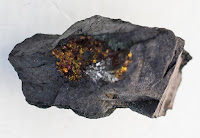
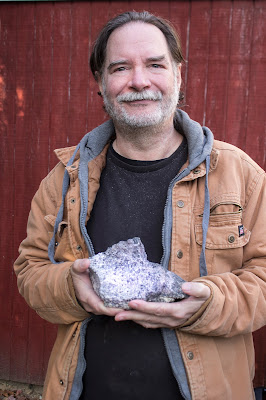
In addition to the few pieces displayed under glass in the Gallery, Dr. Francis removed other Maryland minerals locked beneath them in wooden cabinets. From a spacious lab and study area in the Museum's basement, he selected more Maryland pieces from the thousands of specimens in drawers surrounding the desk where he sits in our title picture. After making a special trip to another building where the micromount collection is kept, he walked with me across campus to a house where rows of floor to ceiling drawers filled with hand specimens line the basement. There he made several trips up a ladder to fetch those from Maryland, the most interesting of which we carried back to the museum in a shopping bag for me to photograph.

Upon leaving just before dark, it was clear to me the day's experience was to be a source of substantial content for future Mineral Bliss posts. How welcome to have this material to share during an upcoming six week period where Holidays and extensive travel could easily supersede the kind mineralogical pursuits covered at Mineral Bliss that are normally a routine part of my life. Here are a few likely topics.

  • Maryland minerals on display in the Harvard Mineralogical Museum that were missed during our August visit.

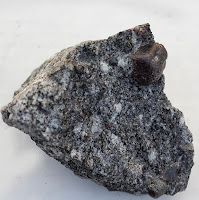
  • Maryland minerals of special interest that are not on display.

  • Curious issues regarding the identification of several Maryland pieces.

Stay tuned.

Saturday, December 5, 2009

A Classic Pennsylvania Calcite

The Mineral Bliss post from November 14, 2009, which described an escorted visit to the Delaware Mineralogical Museum, made the following statement: "I've deliberately refrained from mentioning one Pennsylvania specimen in particular to share its story as the sole topic of a future Mineral Bliss post."

It was the calcite specimen shown in the above picture from the Delta Carbonate Quarry, now known as the York Building Supply Quarry, in York, Pennsylvania. With a main crystal measuring about 4 1/2 inches across, I've never observed a more appealing example of this classic genre. Upon learning from the Delaware Mineralogical Museum Curator Sharon Fitzgerald that its original source was one of my favorite collector/dealers, I immediately decided to contact him.

Eric Meier of Wilmington, Delaware, is pictured at left behind tables of his inventory at the Delaware Mineralogical Society's show this past March. Trading as Broken Back Minerals, he was among the busiest dealers there. Likewise, at the September Gem Cutters Guild of Baltimore Show in the Howard County Fairgrounds, November's Roanoke Valley Gem and Mineral Show at the Salem,Virginia Civic Center, and other East Coast events. He carries substantial regional material. His prices are quite reasonable to begin with and become increasingly so for customers who purchase in quantity.

Eric informed me that a threesome also including his friends Bill Longacre and Joe Hoffman collected this magnificent calcite specimen together in 1993. They were at the bottom of the quarry when Hoffman noticed a small hole about 25 feet up a scalable slanted wall. By chiseling away at the brecciated limestone surrounding the hole, they succeeded in opening up a pocket completely lined with crystals. About eighteen inches high and ten to twelve feet wide, the pocket tapered back approximately eight feet. Once they'd opened the pocket, removing the crystals therein became more difficult. Limestone that was not brecciated surrounded them. The men shoved a blanket into the pocket to protect what crystals they could dislodge, then hammered and chiseled away. When finished, they agreed to divide the booty and rolled dice for first pick. Eric rolled a double six for the piece now in the Delaware Mineralogical Museum. It required minimal cleaning.

Skip Colflesh, whose ruizite find at Cornwall, PA, was the subject of the June 13 Mineral Bliss post, also collected large quantities of calcite at this York locality between 2000 and 2002 in the company of fellow legendary Pennsylvania collectors Bryon Brookmyer and Bob Weaver. Skip authored a well illustrated article about the genre that appeared in the September/October 2002 edition of Rocks and Minerals. In a recent Email to me, he mentioned "crystals up to ~8" and the subsequent discovery in 2003 of a pocket with even more diverse crystals.

The crystals are often twinned or stacked. Sometimes they appear ball-like. Their forms range from rhombs to prisms to scalenohedra. This diversity along with a distinctive orange/ honey/ amber coloration distinguishes them. Similar crystals have been collected at another nearby York Building Supply owned quarry known as the Thomasville Quarry. While both localities have been off-limits to collectors for years, plenty of calcite from them remain available on the market and grace both museums and personal collections.

Saturday, November 28, 2009

Uncovering a Spectacular Maryland Specimen


The above pictured spessartite garnet atop schorl tourmaline is one of two Maryland specimens displayed in the University of Delaware Mineralogical Museum. As I photographed it, the Museum's curator, Dr. Sharon Fitzgerald, informed me that her husband, Dr. Peter Leavens, had dislodged it from a road cut near Elkton. How on earth did he do it, I wondered, and exactly where?

Dr. Leavens is currently Emeritus (retired) Professor of Geology at the University of Delaware, where he taught for 38 years. He was also Curator of the Mineralogical Museum from 1972 to 1997, and is married to the museum's present curator, Dr. Fitzgerald. At her bidding Dr. Leavens wrote up for me what happened. Here is his story:

On the official Maryland state highway map, Appleton is marked as the most northeasterly town site in the state, although there is nothing there except a convenience store at the crossroads where Appleton Road, connecting Elkton, MD and Kemblesville PA, crosses MD 273.

In the mid 1970s I was teaching at the University of Delaware and living in Kemblesville. My commute took me down Appleton Road and into Delaware on 273. One day in late summer I saw that a development road (now North Edgewood Drive) was being built off Appleton Road to the east, a few hundred yards north of the crossroads.


Scouting along the road, I found some large quartz boulders which had been plowed out of the roadbed and piled on the bank. The road had cut across a pegmatite, about four feet wide and at least as long as the road width. Judging from the limited outcrop exposed in the road, the pegmatite had an outer quartz-feldspar zone and a discontinuous quartz core; the boulders on the bank were pieces of the core. What got my attention were the crisp outlines of several black schorl tourmaline and tan microcline crystals embedded in the margins of the quartz core boulders.

I had my sledge hammer in the car, so I got it out and began beating on the quartz boulders, hoping to jar the crystals loose, and I was able to recover several tourmaline crystals and part of a microcline crystal. By far the best specimen is a 2.5" tall schorl capped by two 1" garnet crystals. One garnet, which had not been protected by the quartz, had crumbled almost completely away, but the other is a crisp trapezohedron. One corner of the tourmaline came out in several fragments and had to be repaired, but overall it is a beautiful specimen.

The bedrock geologic map of northern Delaware shows that the northwest corner of New Castle County, including part of Newark, contains abundant pegmatites. During the building of West Branch development in Newark in the 1990’s, a number of pegmatites were unearthed that produced schorl tourmaline, a few beryl crystals, and some small garnets. The Appleton occurrence is only about three miles west of West Branch and may be part of the same pegmatite swarm.

If so there may be other finds to be made in the northeast corner of Maryland. Unfortunately, both the Appleton and the West Branch pegmatites are covered, and no traces of them remain.


Contributed by

Dr. Peter Leavens

Saturday, November 21, 2009

Minerals from the State of Delaware

Delaware surely must yield the least variety of mineral specimens of any other state in the US. That's because a coastal plain consisting of sand and sediment underlies most of it. Delaware's relatively few collectible minerals confine themselves to a diminutive tract of Appalchian Piedmont in the far northwest part of the state.

Delaware's State Mineral is sillimanite. The specimen shown beneath our title was collected at Brandywine Springs. A polymorph of kyanite and andalusite, gemologists refer to sillimanite when gemmy and transparent as fibrolite. I've also heard it called Delaware's State Gem. Give Delaware credit. Half the states in the US don't have a state mineral. Recognize them as well for its first class mineralogical society and the wonderful mineralogical museum at the University of Delaware.

Although the university of Delaware Mineralogical Museum has yet to exhibit Delaware minerals, next door at 257 Academy Street in the Delaware Geological Survey, a cabinet on the second floor features several impressive Delaware specimens. At top left are apatite crystals from Dixon's Quarry in Woodale. Below it are almandine garnet crystals from a no longer accessible locality beneath the homes of a Newark neighborhood known as West Branch. The beryl at top right is also from West Branch; so are the curved schorl tourmaline crystals pictured beneath it. In addition to showing me these minerals and allowing me to photograph them, Dr. Fitzgerald accommodated me similarly with other Delaware material in storage at the Museum.

With the West Branch locality extinct, Wilmington's Brandywine Quarry---not to be confused with the Brandywine Springs sillimanite locality---probably has Delaware's most extensive variety of minerals with 18 entries including 14 valid minerals noted in Mindat. The orange chabazite pictured at left especially impressed me among Brandywine Quarry minerals. Chabazite is one of four zeolites known to occur here along with stilbite, laumontite, and natrolite.

The stilbite pictured at left attracted my interest. It came from a road cut along I-95 near Naaman's Road. And the historic magnetite at right in a sheet of muscovite from Chandler's Hollow (Beaver Valley) in Newcastle County fascinated me. To see images of the the Delaware minerals shown in this post and other Delaware minerals that I photographed during my recent visit to the University of Delaware Mineralogical Museum, please follow the link to this set on my Flickr Site.

Saturday, November 14, 2009

University of Delaware Mineralogical Museum: A Private Visit

As Delaware Mineralogical Museum Curator Sharon Fitzgerald removed the glass encasing this Jeffrey Mine vesuvianite for the photograph, it appeared to me to be as close to perfect as any mineral I ever encountered. Vesuvianite was the topic of Dr. Fitzgerald's doctoral thesis in mineralogy, and she was raving about it. This one room museum in Penny Hall on the University of Delaware campus displays a lot more priceless world class specimens than its small square footage would suggest. Although I typically could overlook a genre so common as dolomite, the specimen pictured at right from Navarre, Spain impressed me almost as much as the vesuvianite. Same for dozens of other pieces here, especially as Dr. Fitzgerald encouraged me to pause and contemplate them. She also noted that the serandite with analcime from Mt. Saint Hilaire, Quebec (top left) and the wire sliver piece shown below it from Zacatecas, Mexico, have graced cover pages of Mineralogical Record.


This personal tour followed an email I received from Dr. Fitzgerald responding to our June 6 Mineral Bliss post heralding the museum's reopening after a long period of closure for renovations. Inviting me to return, she spoke of the "amazing collection that is here and the possibilities that surround it." Since my earlier post was based on an all too quick walk-through, I enthusiastically accepted the offer.


The University of Delaware owns over 15 thousand specimens, about four thousand of which have yet to be catalogued. Its mission is to "display the best" and maintain ample material for study. Since twelve years have passed since the Museum's last targeted acquisitions, Dr. Fitzgerald is on the lookout for material from major recent finds, especially in China. She also plans to de-access hundreds of pieces the Museum doesn't need.


Among other plans is to assemble a display of regional minerals. Presently, about a dozen such specimens from neighboring states grace different cabinets as part of other suites or categories. Most are from Pennsylvania. I suspect that the French Creek chalcopyrite shown at top left and also the Woods Mine Brucite at top right are superior to any other of their genres these classic localities ever produced. The Cornwall andradite garnet at bottom right , which is in a visiting case provided courtesy of David Biers, is also amazing. I've deliberately refrained from mentioning one Pennsylvania specimen in particular to share its story as the sole topic of a future Mineral Bliss post. Of two Maryland specimens, the spessartite garnet on schorl tourmaline pictured beneath the chalcopyrite all but blew away this publisher of the Maryland Minerals website. Dr. Fitzgeralds's husband, Dr. Peter Leavens, who curated the Museum for a 25 year period beginning in the 1970's, collected it in a Cecil County roadcut near Elkton.

So what about Delaware minerals? Though Delaware is hardly a mineral collectors' haven, a few choice specimens including schorl tourmaline, spessartine garnet, and beryl are in a display cabinet next door at the Delaware Geological Survey, 257 Academy St. A wider selection of remarkable Delaware minerals is under lock and key in the basement of Penny Hall beneath the Musuem. I managed to photograph the best from both caches. You can see pictures and read about them in an upcoming post entitled The Minerals of Delaware.

Saturday, November 7, 2009

Jonathan Ertman: Maryland's Mr. Hunting Hill Garnet

Jon Ertman's nickname, "Maryland's Mr. Garnet," recognizes him as the premier aficionado, collector, and dealer to specialize in the grossular garnets from Hunting Hill Quarry in Rockville. Hunting Hill garnets may well have become Maryland's best known and most sought after contribution to the mineral kingdom. Jon's role with them has evolved over the 37 years since he moved with his family as a pre-teen from upstate New York to Rockville. Already a rockhound, he found his way the several miles from his new home to Hunting Hill in a matter of days.

Jon surmises that he's collected at Hunting Hill a couple hundred times. "Before OSHA," he recalls, " you could just sign a waiver at the gate to go in and collect." Today the quarry grants access only by pre-arrangement at specified times exclusively with clubs and groups that carry insurance. Jon is an active member of both the Montgomery County Mineral Society and the Northern Virginia Mineral Society, which share Hunting Hill as their most popular field trip destination. No other Maryland locality yields such a wide variety of minerals, 69 at last count. Hunting Hill is the only Maryland locality for many of these species. Some, such as pokrovskite and xonotlite, rarely occur anywhere else in the world.

Jon also takes pride in his suites of minerals from such no longer accessible Northern Virginia localities as Centreville Quarry, Bull Run Quarry, Luck Quarry, Chantilly Quarry, and Goose Creek Quarry. His collection also holds an enormous quantity of worldwide minerals. They dominate the inventory he sells at regional swaps and shows, although he emphasizes that every mineral in his collection is for sale.

Notwithstanding, Jon's Hunting Hill grossular garnets reign supreme. Displays such as pictured at left are prominent in his sizeable basement. Hundreds of smaller pieces, including plenty of thumbnails, fill flats lining the wall. The crystals typically ocur in a serpentinite-rodingite matrix and sometimes associate with very attractive light green clinochlore crystals. Of all the Hunting Hill garnet pieces in Jon's collection, his favorite is the one pictured at right. For aesthetics and quality, he sees it as representing the best of a classic genre. He'll sell it for $1000. If that's too much for the budget, plenty of very attractive smaller pieces go for less than $10.

Jon has sent some of his Hunting Hill garnets to Thailand for faceting. He charges about $80 a carat for these cut stones and is in no big hurry to sell them. Yours truly may have been among the first to get in on this one. Pictured at right is my wedding ring, in the center of which a Hunting Hill garnet that Jon collected has replaced the original diamond. At present, it's one of but a very few jewelry items anywhere to feature such a stone.

However unusual my ring, I have yet to see any jewelry bearing Patuxent River agate. Maryland's legislature chose this alleged manifestation of silicified dinosaur bone a few years ago as the State's official gemstone. Confident that most Maryland jewelers, geologists, and members of the rockhound community agree with him, Jon Ertman proclaims they should have picked Hunting Hill garnets.

Jon can be reached at grossular9@live.com.

Saturday, October 31, 2009

Beach Pebble Fun in Marin County

Spending the past few days in San Francisco with a busy schedule, I'd anticipated this would be the first week since launching Mineral Bliss last February that there wouldn't be a post. It was a pleasant family oriented trip, however, into which my son Alex and I were able to squeeze in a few hours for a hike. As we scanned his trail book to pick one, I saw "semi-precious stones" mentioned in conjunction with the "Rodeo Beach Hike." Parking to reach the trail was directly at Rodeo Beach. We drove there and headed out, making it approximately two hundred yards to near the shoreline. Thereafter, we were rarely off our knees.

The picture atop this page is of pebbles ranging in size from about five millimeters to one and a half centimeters. It includes a number of less common pebbles that I'm reluctant to identify without help. Most of what's green is serpentine from the serpentinite rocks abundant in the adjacent Marin County headlands. These headlands are also rich in chert that can be gray, green, red, blue, or brown.
Other beaches along San Francisco Bay yield similar pebbles. Pictured at left are a few that my son Alex picked up several months ago across the Bay at Baker Beach, which is within the San Francisco city limits. I first suspected that the red and brown pebble at center right could be an agate, but am now convinced that it's chert or possibly jasper. One of Marin County's beaches is known as Agate Beach. From the Web, I'm told that many grains of sand there are from agates, but that marine fossils are a better bet for collecting than agate.

Serpentinite pebbles from both Rodeo Beach and Baker Beach remind me of the "jade" that I recall checking out years ago at Jade Beach along the Pacific a couple hundred miles south in the Big Sur. At Jade Beach, the stones are are much larger. Some are actually boulders. They are said to be jadeite and/or nephrite. I'd enjoy the opportunity to compare the Jade Beach material with some of these pebbles.